


AI integrated for visionary CTOs
Chief Technology Officer (CTO) Programme
Transform AI and tech disruption into impact
- Become Eligible for ISB Executive Alumni Status
- Insights into Gen-AI and Intelligent Ecosystems
- Capstone Project and Action Learning Projects
- In-Person Immersion at ISB Campus
Early Enrolment Benefit
This Republic Day, embrace new opportunities to learn and grow by acquiring essential skills.
Enrol before Invalid liquid data to avail 4% enrolment benefit. Take the first step towards growth, today | Application Fees:Invalid liquid data
Lead the AI-Native Future
94% of tech leaders are accelerating the development of AI-native ecosystems (PWC Pulse Survey 2025). This surge underscores the growing expectations on CTOs to not only manage technology but to strategically shape the AI-driven future of their organisations. Today, CTOs are expected to go beyond traditional technology management—they must be architects of innovation, strategists for enterprise transformation, and stewards of resilient digital ecosystems. Managing technical debt, future-proofing architectures, and integrating emerging technologies have become critical responsibilities.
The Advanced CTO Programme prepares technology leaders to meet these evolving demands. Participants gain the expertise to harness AI and emerging technologies, strengthen cybersecurity resilience, and lead enterprise-wide innovation initiatives. Designed for accomplished professionals with significant leadership experience, this programme is a premier pathway to C-suite excellence, enabling you to shape the future of technology and business strategy.
Programme Highlights

15+ sessions with success coach
Weekly live-online sessions* to support, guide and accelerate your learning

Certification from ISB
Certificate of completion from ISB Executive Education

Immersion and networking at the ISB
with diverse peers and faculty during the 1-day campus visit.

One-on-one with a success coach
Access to success coach to drive engagement and clarity via live-online sessions

A Capstone Project
Work on capstone project and learn with peers from across industries

Action Learning Projects
Couple of Action learning projects guided by success coach

7+ live sessions with industry leaders and ISB faculty
Gain cutting-edge insights from faculty and industry leaders

ISB Executive Alumni Status
Become eligible for ISB Executive Alumni Benefits.
notes: - For the on-campus networking session, participants will be responsible for making their own travel and accommodation arrangements. - This is primarily a self-paced online programme, supplemented with live sessions led by industry experts and ISB faculty. Participants also engage in weekly interactions with a dedicated Success Coach, who provides structured support, guidance, and facilitates deeper understanding throughout the learning journey.
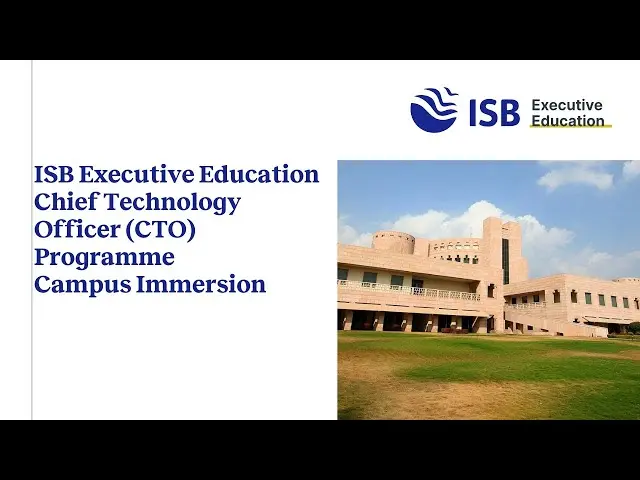
Campus Immersion
AI-Focused Live Sessions and Masterclasses
Engage in dynamic masterclasses and live sessions led by industry leaders and faculty, covering cutting-edge topics in technology, strategy, and leadership.

Building GenAI driven products at scale: Strategies for CTO

AI budgeting and ROI: FinOps strategies for tech leaders

GenAI at the frontier of cybersecurity: A CTO's guide to threat mitigation

IT governance in the age of AI

Integrating agentic AI solutions into existing enterprise workflows

Financial management for CTOs

Mastering AI CoEs: Building and leading next GenAI teams
Note: Live sessions are subject to change at the discretion of the ISB faculty.
Case Studies









Note:
All product and company names are trademarks or registered trademarks of their respective holders. Use of them does not imply any affiliation with or endorsement by them.
Why ISB Executive Education?
#1
#27
#19

Who Is This Programme For?
Current and future CTOs aiming to elevate their strategic leadership and spearhead enterprise-wide digital transformation.
Senior technology executives such as VPs of Engineering or Heads of Architecture who play a pivotal role in defining and executing technology roadmaps.
Technology consultants and leaders charged with assessing, implementing, and scaling emerging innovations to unlock sustainable business growth.
Eligibility: Minimum 10 years of work experience as on the programme start date
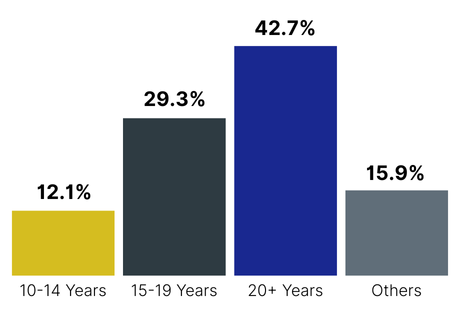
Past Participant Profile
Work Experience
Top Industries
IT/ Technology
BFSI Industry
Financial Services
Banking
Others
*Other industries include Engineering, Energy/Utilities, Health Care/Health Services, etc.
Top Titles
VPs
Functional Heads
CTOs and CIOs
Senior Technology Consultants
Others.
*Other title include Technology Leaders, AI Leaders, Senior Directors, etc.
Where past participants come from











Disclaimer: All product and company names are trademarks or registered trademarks of their respective holders. Use of product and company names does not imply any affiliation with or endorsement by the holders.
The list of companies is only indicative and not exhaustive.
ISB CTO programme outcomes

Gain a strategic perspective on technology, data, and AI, and understand their role in shaping organisational strategy and growth.

Evaluate emerging technologies and apply them to build intelligent, secure, and sustainable business and supply chain systems.
Align technology and AI investments with business goals to drive innovation, resilience, and long-term advantage.

Develop the leadership, governance, and financial skills needed to lead technology-driven organisations in a changing world.
Participant Testimonials






Programme Modules
Explain the primary responsibilities and core competencies of a Chief Technology Officer (CTO).
Differentiate between the roles of a Chief Technology Officer (CTO) and a Chief Information Officer (CIO).
Articulate how value is delivered by the CTO.
Analyse the essential skills and competencies required of a CTO.
Articulate the concept of the digital economy and its key drivers.
Analyse the implications of the key drivers of the digital economy.
Identify the challenges and opportunities the digital economy presents.
Analyse the characteristics of new digital ecosystems.
Implement effective strategies to compete in the new digital economy.
Explain digital business models and their significance in the modern business landscape.
Evaluate existing digital business models to identify their key components and value propositions.
Articulate the key factors that help identify the sweet spots for digital innovation.
Develop digital innovation skills in a rapidly evolving technological landscape.
Explore the different approaches to digital business model innovation and their application in various industries.
Discuss the best practices of digital business model innovation approaches in various industries.
Manage a digital innovation portfolio to drive organisational growth and competitive advantage.
Examine the pathways to generate and deliver digital value in a business context.
Explore insights into revenue models, value propositions and monetisation strategies.
Examine the role of a CTO as a technical architect in translating business strategy into technology strategy.
Identify the skills of a technical architect.
Evaluate the key criteria to select appropriate technologies to build a robust technology platform.
Assess emerging technologies shaping the digital economy.
Identify the challenges in developing and implementing a technology strategy.
Examine best practices for implementation and management of a two-speed architecture.
Apply appropriate SDLC models (Agile, Scrum, Kanban, DevOps) to optimize speed, quality, and collaboration in product development.
Integrate customer-centric tools like personas and journey maps to ensure product-market fit and drive user adoption.
Balance rapid MVP delivery with scalable architecture to minimize technical debt and enable long-term growth.
Align product development with Go-To-Market (GTM) strategy through cross-functional collaboration with marketing and sales.
Leverage data-driven roadmapping, experimentation, and feedback loops to prioritize features and guide strategic decisions.
Interpret the paradigm shift driven by Generative AI and its implications for enterprise strategy.
Examine key use cases of Generative and Agentic AI across industries.
Assess opportunities and risks, including hallucinations, deepfakes, and security challenges.
Recognize the ethical and legal considerations of adopting Generative AI.
Differentiate between Generative AI as a strategic enabler and its role within broader digital transformation frameworks.
Evaluate enterprise applications of blockchain and Web3 technologies.
Assess ROI-driven industrial use cases of AR, VR, and digital twins in various sectors.
Analyse the convergence of AI and decentralised systems in autonomous environments.
Apply conversational AI and retrieval-augmented assistants that enhance compliance, productivity, and customer experience.
Evaluate the economic models of AI (training, inference, cloud consumption, SaaS GenAI pricing).
Align AI investments with enterprise strategy by defining measurable value drivers and guardrails.
Analyse vendor pricing models and negotiate contracts to optimise cost-performance trade-offs.
Develop approaches to measure ROI for AI initiatives, accounting for productivity gains, risk mitigation, and compliance costs.
Evaluate current global technology regulations and AI-specific legislation, including their implications for enterprises.
Assess cybersecurity trends and emerging threats such as ransomware, deepfakes, and LLM-driven attacks.
Analyse AI risk governance frameworks and their application in enterprise contexts.
Develop strategies for enterprise-wide compliance, including coordination between CTOs, CISOs, and legal teams.
Evaluate the impact of cyberattacks on organisations and design resilient cybersecurity architectures.
Design and implement effective IT governance structures.
Identify and manage technology risks to improve resilience.
Strengthen cloud and vendor governance for cost, security, and compliance.
Align IT decisions and metrics with business goals.
Balance innovation with accountability in governance processes.
Apply responsible AI principles to ensure ethical and transparent use of technology.
Explain the role of business and supply chain analytics in optimising value chains.
Analyse the key drivers of supply chain performance and distinguish between supply and value chain perspectives.
Evaluate AI infrastructure and data architectures to enable real-time orchestration.
Assess how ERP and platform modernisation with AI improves scalability and workflow integration.
Apply supply chain analytics to improve decision-making in retail and enterprise contexts.
Analyse supply chain drivers to optimise logistics and network performance.
Evaluate the use of digital twins and simulation models for resilience in global supply chains.
Assess AI-driven demand sensing and forecasting methods for accuracy in volatile markets.
Examine advanced techniques such as autonomous decisioning and prescriptive analytics for network optimisation.
Apply AI and analytics for sustainable demand forecasting, supply planning, and real-time visibility.
Evaluate supplier risk, ESG performance, and carbon footprint using sustainability metrics and tools.
Analyse platform-based orchestration and automation technologies shaping next-generation supply chains.
Assess digital supply chain maturity, push–pull dynamics, and coordination models.
Examine governance, privacy, and regulatory compliance in AI-powered and sustainability-driven supply systems.
Explain the role and responsibilities of CTOs in financial management.
Apply budgeting and forecasting techniques to plan and allocate resources effectively.
Use financial reporting and analysis tools to monitor and measure the performance of technology initiatives.
Develop and present compelling business cases for technology investments to senior management, investors, and customers.
Differentiate AI-specific financial models from general budgeting and forecasting practices.
Assess, identify, and implement opportunities for automating business processes.
Develop the capability to foster a culture of innovation by effectively implementing Agile and DevOps methodologies.
Develop a comprehensive technology strategy that aligns with organisational goals.
Evaluate how AI can serve as a strategic lever in digital transformation and enable data-driven decision-making
Apply AI-first thinking to design execution strategies that accelerate innovation and organizational impact
Understand the importance of change management for successful digital transformations in organisations.
Identify common reasons for resistance to change in organisations.
Explore and choose effective strategies to overcome resistance to change.
Create a detailed plan outlining the steps needed to manage strategic change in organisations.
Understand the concept and principles of team management and their implications for CTOs.
Compare the different leadership styles and their suitability for different situations and contexts.
Develop a team management strategy that aligns with the organisation’s vision and culture.
Use real-world case studies to apply leadership strategies in response to rapid technological changes.
Simulate the execution of technology-driven strategies, troubleshooting potential obstacles.
Participate in role-playing scenarios that mirror common challenges faced by CTOs.
Understand the concept and principles of business continuity and their implications for CTOs.
Defining the processes and metrics for managing risk.
Apply the steps and methods of risk management to identify, assess, and treat risks that may affect their organizations.
Create and execute a crisis management playbook to prepare for and respond to landmark crisis events.
Understand how professional networks impact adopting and adapting to technological change within organisations.
Evaluate effective leadership approaches to prepare teams for technological change.
Analyse the importance of effectively communicating the 'why' behind technological initiatives.
Demonstrate an understanding of storytelling as a strategic communication tool in technology leadership.
Apply storytelling techniques to communicate technological concepts and initiatives for maximum impact.
Identify key elements necessary for crafting compelling and impactful stories in a professional context
Key Programme Faculty

Visiting Faculty, ISB, Dean of the Wisconsin School of Business
Vallabh (Samba) Sambamurthy is the Albert O. Nicholas Dean of the Wisconsin School of Business. Recognized as an impactful administrator, attentive leader, and preeminent scho...

Visiting Faculty, ISB, Professor, Statistics, Operations, and Data Science, Fox School of Business and Management
Professor Subodha Kumar is the Paul R. Anderson Distinguished Chair Professor of Statistics, Operations, and Data Science and the Founding Director of the Center for Business ...

Visiting Faculty, ISB, Associate Professor, Strategy, Fisher College of Business, Ohio State University
Professor Srikanth’s research investigates how to design organisations and inter-organisational relationships to be more effective and more innovative. He has studied mergers ...

Adjunct Professor, Marketing (Practice), ISB
Professor Nandu Nandkishore is a global C-suite executive with over 34 years of experience in leadership roles across a diverse set of environments in both emerging and develo...
Note: - Programme Faculty for the live sessions might change due to unavoidable circumstances, and revised details will be shared closer to the programme start date.

ISB Executive Alumni Benefits
Access to the Executive Alumni portal – a unique space for alumni to re-ignite connections, spark collaborations and engage in continuous learning. The alumni portal has several features like an alumni directory, city chapters, special interest groups, alumni mentorship and more. Access to the alumni portal is provided post the programme completion.
Networking opportunities via ISB Executive Education Network Group on LinkedIn.
Preferential pricing with 10% discount on programme fee on ISB Executive Education programmes.
ISB Executive Education newsletters, articles, podcasts and videos.
Access to ISB Executive Education support team over email.
Exclusive invitations to Online and Offline events like Webinars, Conferences, and Master Classes, amongst others.
Opportunity to be a Guest Speaker at ISB Executive events (invited on the discretion of ISB Executive Education).
ISB Executive Alumni Credentials: ISB Email ID.
Note:
All activities and research resources for ISB Executive Education alumni are handled by ISB Executive Education. Whenever there are any events or webinars held, they will be informing the alumni community of the same. Events take place yearly basis availability of resources & is subject to change.
All alumni benefits are subject to change based on ISB’s prevailing alumni benefits policy. The school reserves the right to modify or withdraw any benefit at its discretion without prior notice.
1-day Campus Immersion at ISB

Networking Sessions – Connect with professionals and industry peers.

Faculty-Led Discussions – Gain insights directly from ISB’s renowned faculty.
Peer Networking – Share experiences and perspectives with cross-industry leaders.

Campus Immersion – Engage in an enriching on-campus learning experience.
*Participants will have to make their own arrangements for travel and accomodation
*These activities may vary from cohort to cohort.
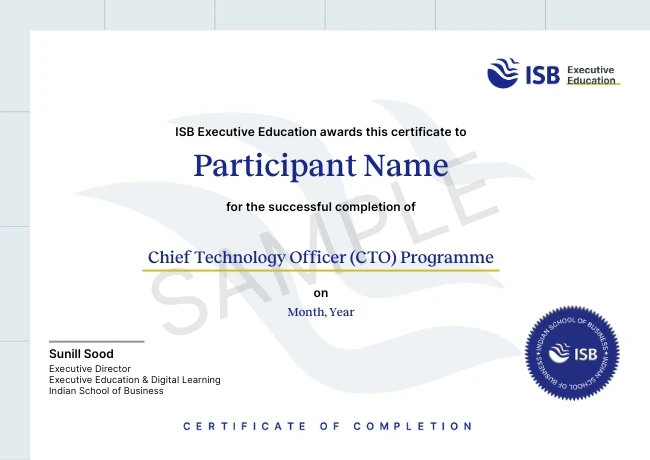
Programme Certificate
Upon successfully completing the programme with a minimum 70% score, you will be awarded a certificate for the Chief Technology Officer programme from ISB Executive Education.
Note:
All certificate images are for illustrative purposes only and may be subject to change at the discretion of ISB Executive Education.
Recordings of masterclasses by industry experts may or may not be made available, at the discretion of the industry experts. Emeritus or the institute does not guarantee availability of any live session recordings.
Programme FAQs
The ISB Executive Education’s Chief Technology Officer Programme (CTO) is an executive education initiative designed to equip senior technology professionals with the strategic leadership, innovation, and management skills required to excel in the CTO role. The programme is carefully crafted to address the evolving challenges faced by technology leaders in today's fast-paced business environment.
The ISB Executive Education’s CTO Programme is ideal for experienced technology professionals, senior IT managers, and leaders who aspire to take on the Chief Technology Officer position. This programme is also highly beneficial for current CTOs looking to deepen their strategic expertise and drive innovation within their organisations.
The Chief Technology Officer Programme at ISB Executive Education offers participants a unique opportunity to enhance their leadership capabilities, gain insights into cutting-edge technology management practices, and develop a strategic vision for their organisations. The programme emphasises real-world applications, empowering CTOs to lead technological transformation and drive business success.
The ISB Executive Education CTO Programme is distinguished by its focus on leadership, digital transformation, and innovation. Participants benefit from the expertise of ISB Executive Education’s world-renowned faculty and industry leaders, ensuring that the learning experience is both relevant and impactful. The programme’s rigorous curriculum is tailored to meet the specific needs of CTOs and aspiring technology leaders.
The ISB Executive Education’s Chief Technology Officer programme is structured to provide a flexible yet comprehensive learning experience. Delivered through a blend of online sessions and immersive in-person modules, the programme spans 24 weeks, allowing participants to balance their professional responsibilities while engaging in this transformational journey.
The CTO programme at the ISB Executive Education covers a wide range of critical areas, including technology strategy, innovation management, leadership, and digital transformation. The curriculum is designed to provide a deep understanding of the CTO role, preparing participants to lead their organisations in navigating the complexities of the modern technological landscape.
To apply for the ISB Executive Education’s CTO Programme, prospective candidates can fill out the inquiry form on the official programme page and complete the online application. The selection process is designed to identify professionals who will benefit most from the programme’s offerings and contribute to a dynamic learning environment.
Yes, upon successful completion of the Chief Technology Officer Programme, participants will be awarded a certificate from the Indian School of Business (ISB) Executive Education. This certification reflects the participant’s readiness to take on the responsibilities of a Chief Technology Officer.
Details regarding the fee structure for the ISB Executive Education CTO Programme, prospective participants can fill in the inquiry form on this page or connect with our programme advisors for more information. The fees are structured to reflect the comprehensive and high-impact nature of the programme, with various payment options available to suit the needs of senior professionals. Programme Fees: INR 6,31,000 + GST Flexi payment options and loans available
Candidates applying for the CTO Programme are expected to have 10+ years of professional experience in technology management or a related field. The programme is designed for senior professionals who are either currently in or aspiring to move into the Chief Technology Officer role, ensuring a cohort of high-caliber participants.
Yes, ISB Executive Education’s CTO programme offers Executive Alumni status. Additionally, you also get access to the Executive Alumni portal – a unique space for alumni to re-ignite connections, spark collaborations and engage in continuous learning.
Participants will learn to leverage Generative AI for enterprise strategy, evaluate its risks—including hallucinations, deepfakes, and security vulnerabilities—and apply ethical and legal frameworks for responsible adoption. The program also equips CTOs to assess industrial applications of blockchain, Web3, AR/VR, and digital twins, integrating conversational AI to drive enterprise productivity and compliance across diverse business functions.
The curriculum empowers tech leaders to analyze evolving AI economics—covering cloud consumption, inference, and SaaS GenAI pricing—as well as to define value drivers and build defensible business cases for AI investment. Alongside, CTOs will master advanced AI risk governance frameworks, interpret global technology regulations, and design robust cybersecurity strategies to mitigate threats from ransomware, deepfakes, and LLM-based cyberattacks.
Early registrations are encouraged. Join now.
Flexible payment options available.
Starts On