


Batch 12
Venture Capital and Private Equity Programme
- #1 in India in the Financial Times (FT) Executive Education Custom Rankings 2025
- Live sessions with ISB faculty and industry expert
- VC Circle Premium subscription included
- ISB Executive Alumni Status
Unlock Your Potential
This Republic Day, embrace new opportunities to learn and grow by acquiring essential skills.
Enrol before Invalid liquid data to avail 4% enrolment benefit. Take the first step towards growth, today | Application Fees:Invalid liquid data
Programme Overview
Enroling in the Venture Capital and Private Equity Programme by the ISB Executive Education provides a comprehensive foundation in the principles and practices of venture capital and private equity globally. This programme is designed to equip leaders with:
Leadership strategies: To guide teams in identifying high-impact ventures.
Insights: In market trends to discern promising startups from those less likely to succeed.
By delving into real-world case studies and current market data, participants will gain thorough understanding of the factors driving success in India's burgeoning startup environment. Programme curriculum includes topics like valuation and deal flow, public offerings like IPOs M&A and leadership through disruption, venture capital funding, deal structuring, valuation techniques, and exit strategies.
Upon successfully completing the programme, you will be awarded a certificate from ISB Executive Education.
Why ISB Executive Education?
#1
#27
#19
#4
Programme Highlights

100+ Pre-recorded video lectures* for self-paced learning from renowned ISB faculty

2 Live sessions by ISB faculty

6+ Masterclasses by industry experts

1 Capstone project

2 Action learning activities

10+ Weekly live sessions for doubt solving/networking
Note:
*This is a self-paced online programme with Few Exclusive Live Sessions by ISB Faculty and some masterclasses by industry experts. We have a curated panel of success coaches who will be conducting the weekly live doubt-clearing sessions.
**Assignments are graded either by industry practitioners who are available to support participants in their learning journey and/or by the Emeritus grading team. The final number of quizzes, assignments and discussions will be confirmed closer to the programme start.
Live Webinar with ISB faculty's recordings may or may not be made available, at the discretion of faculty members. Emeritus or the institute does not guarantee availability of any session recordings.
Office hours are weekly live connects with the Programme Leader/Success Coach for query resolution.
Cutting-edge Masterclasses

Mastering Investment Analysis: From Quality Metrics to Market Dynamics

Strategic Insights in Venture Capital: Thematic Investing, Power Laws, and Performance Metrics

Navigating Deal Sourcing: Essential Tools for Venture Capital Success

Alternative Venture Capital: Real-World Examples and Strategies

Comprehensive Equity Strategies: Private, Public, and Global Perspectives

Mastering Private Equity: Metrics, Success Factors, and Avoiding Pitfalls

In-Depth Analysis of SPACs and Deal Syndication: Case Studies and Market Insights
ISB Executive Alumni Benefits
Access to the Executive Alumni portal – a unique space for alumni to re-ignite connections, spark collaborations and engage in continuous learning. The alumni portal has several features like an alumni directory, city chapters, special interest groups, alumni mentorship and more. Access to the alumni portal is provided post the programme completion.
Networking opportunities via ISB Executive Education Network Group on LinkedIn.
Preferential pricing with 10% discount on programme fee on ISB Executive Education programmes.
ISB Executive Education newsletters, articles, podcasts and videos.
Access to ISB Executive Education support team over email.
Exclusive invitations to Online and Offline events like Webinars, Conferences, and Master Classes, amongst others.
Opportunity to be a Guest Speaker at ISB Executive events (invited on the discretion of ISB Executive Education).
ISB Executive Alumni Credentials: ISB Email ID.
Note:
All activities and research resources for ISB Executive Education alumni are handled by ISB Executive Education. Whenever there are any events or webinars held, they will be informing the alumni community of the same. Events take place yearly basis availability of resources & is subject to change.
All alumni benefits are subject to change based on ISB’s prevailing alumni benefits policy. The school reserves the right to modify or withdraw any benefit at its discretion without prior notice.
Who is this Programme for?
Professionals with 5+ years of work experience who are looking to embark on their journeys in the VC & PE domain and network with like-minded peers.
Professionals looking to take significant strides in the VC & PE sector, who want to gain an understanding of sourcing, managing, and structuring deals.
Note: An updated resume and LinkedIn profile is mandatory for application.
Past Participant Profile
Work Experience

Top Industries
Financial Services
Consulting
Manufacturing
Others
*Other industries include Banking, Energy/Utilities, Education, IT/Computers, etc.
Venture Capital Learning Outcomes

Introduction to Venture Capital
Grasp the essentials of venture capital, including its purpose, structure, and significance in funding early-stage ventures.

Emerging Trends in Venture Capital
Explore the evolving landscape of venture capital, dissecting the impact of technology and shifting business models on investment strategies.

Assessing Investment Opportunities
Hone skills in evaluating potential investments, including market potential, growth prospects, and financial metrics analysis.

Exit Strategies in Venture Capital
Analyse various exit routes in venture capital, such as IPOs, mergers and acquisitions, and secondary market transactions, to optimise returns on investments.

Technology in Investment Management
Explore technology's impact on investment management practices, harnessing its potential to leverage emerging trends effectively.
Private Equity Learning Outcomes
Testimonials
Action Learning Activities

Model the venture capital (VC) deal process and hone skills in deal analysis.

Gain hands-on experience in analysing firms using methods such as DCF and multiples.
Programme Modules
Module 1: Venture Capital Industry Overview and Dynamics
Define venture capital and its role in startups.
Identify funding stages and valuation trends.
Understand the Power Law in VC investments.
Explore VC innovation strategies and automation trends.
Summarise key insights on VC’s impact on startups.
Module 2: The Basics of Venture Capital
Understand venture capital fundamentals : firm structure, funding stages, and valuation methods.
Evaluate risks, returns, and investment strategies across the VC lifecycle, including IPOs and acquisitions.
Explore innovation trends shaping venture capital and startup growth.
Module 3: Estimating the Value of an Opportunity
Understand how start-ups identify and evaluate new business opportunities.
Explain the concept of weak ties and their role in opportunity discovery.
Apply the TAM, SAM, and SOM framework to assess market potential.
Analyse the problem-solution fit and evaluate the attractiveness of opportunities.
Evaluate industry and submarket dynamics using Porter’s Five Forces.
Assess business models and competitive advantage through investor and risk filters.
Module 4: Valuation and Deal Flow
Understand the concepts of deal sourcing, deal flow, and stakeholder management in venture capital.
Identify and apply key strategies for an effective deal sourcing process.
Recognise the roles and importance of various stakeholders in a VC deal.
Explain the relevance of valuation and analyse real-world examples like Stripe and WeWork.
Describe the fundamentals and types of due diligence, including technology and industry aspects.
Evaluate founding teams and apply negotiation tips for founder–investor interactions.
Module 5: Investment Management
Understand the core principles of thematic investing and its strategic advantages.
Learn to identify and evaluate potential winning investment themes.
Explore real-world thematic investment cases and global fund examples.
Understand thesis-based investing and its practical execution, including deal structuring, ownership economics, and valuation.
Understand portfolio management strategies including asset diversification across financing rounds.
Module 6: Public Offerings and Indian Regulations
Learn IPO, M&A, and listing strategies from preparation and execution to risk assessment and value creation.
Navigate legal, financial, and regulatory complexities in Indian and global markets for successful exits.
Develop strategies to maximise opportunities while mitigating risks in high-stakes transactions.
Module 7: Impact of Technology in Investment Management
Leverage technology and social media tools for due diligence, market research, and portfolio monitoring.
Apply predictive models and analytics to forecast trends, optimise portfolios, and manage risks.
Overcome challenges in data-driven investing through effective strategies and technological solutions.
Module 8: Alternatives to VC and How VC Fares Relative to Those Alternatives
Explore alternative funding options such as angel investors, crowdfunding, corporate venture capital, and government grants.
Compare funding models and strategies to assess risks, control, and financial impact, with a focus on Indian regulations.
Learn from real-world case studies to build a strategic framework for selecting the right funding source.
Module 9: Advise on Managing Growth
Describe key valuation methods, comparable analysis, and growth trends across funding stages
Explain the stages of a start-up’s funding journey from seed to Series X, including typical VC financing strategies and their implications.
Apply valuation techniques and ownership dilution calculations to real-world start-up scenarios.
Analyse and recommend optimal funding and growth strategies by aligning investor and founder objectives, managing personal goals, and evaluating growth opportunities.
Module 10: Exit Strategies
Apply startup valuation techniques to assess worth and determine fair value during exits.
Evaluate exit strategies such as IPOs, M&A, and strategic partnerships, with insights into Indian market trends.
Develop scaling strategies to achieve growth, efficiency, and profitability while managing operational challenges.
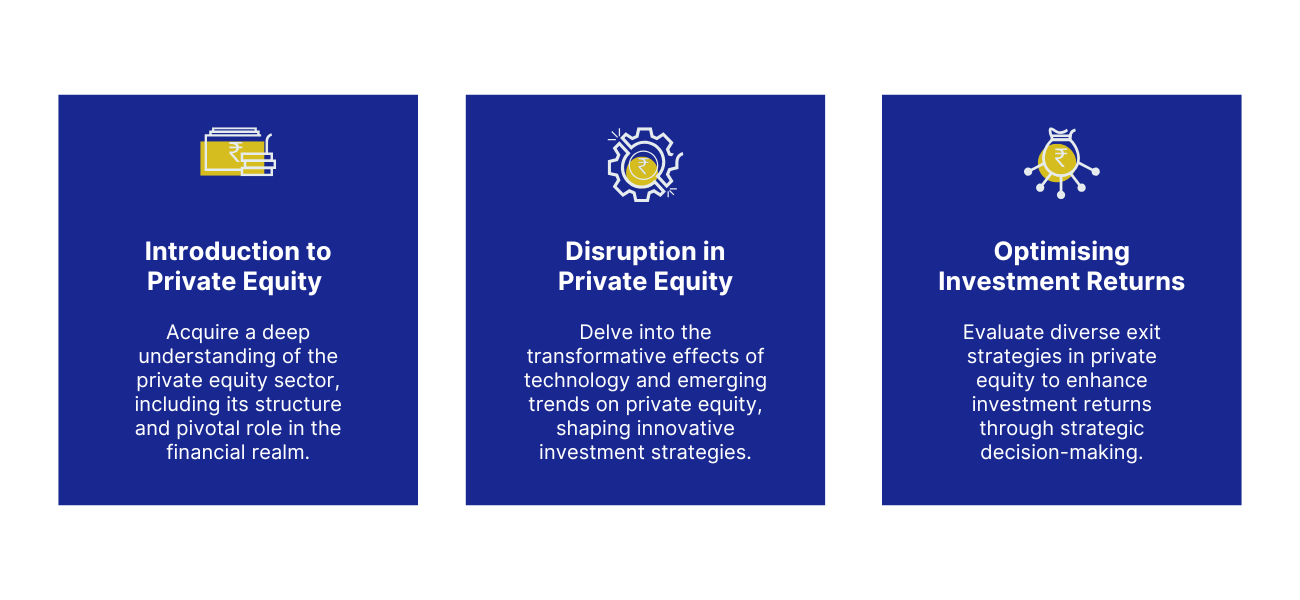
Module 11: Introduction to Private Equity
Understand the definition and role of private equity in the financial ecosystem.
Learn about the evolution of private equity from niche investments to a mainstream asset class.
Identify the key characteristics and features of private equity investment.
Analyse how private equity drives value through growth capital, operational restructuring, and exit strategies.
Apply key principles like the 80/20 rule to understand PE fund performance.
Understand the structure of private equity funds and the roles of General Partners (GPs) and Limited Partners (LPs).
Identify key players and stakeholders in private equity, including portfolio companies.
Gain insight into the organisational structure of a private equity firm, including the roles of managing partners, investment professionals, and support staff.
Examine the relationship between the management team and the investors, including fund structures and fee arrangements.
Analyse the alignment of interests and potential conflicts among stakeholders in private equity deals.
Evaluate the risks, challenges, and potential returns associated with different types of private equity investments.
Analyse the advantages and disadvantages of LBOs, PIPE deals, and growth equity investments.
Module 12: Private Equity Metrics
Understand the importance of PE metrics in evaluating investment performance and guiding strategic decisions.
Learn how to measure key PE metrics such as IRR, MOIC, DPI, RVPI, and TVPI.
Interpret the relevance of each metric in different fund lifecycle stages and across sectors.
Apply these metrics to analyze deals, assess fund performance, and communicate effectively with Limited Partners (LPs), who are the investors in the PE fund.
Module 13: Emerging Trend: Disruption in PE
Understand what a SPAC is and how it works.
Learn the main reasons why SPACs succeed or fail.
Recognise how market conditions affect SPAC deals.
Identify the key parties involved in a syndication deal and their roles.
Comprehend the concept of the buy-and-build strategy and its application in business growth.
Recognise the role of corporate partners in syndication deals and how they contribute to the success of the transaction.
Analyse the benefits and risks associated with the buy-and-build approach.
Assess the potential challenges and considerations when working with corporate partners in syndication deals.
Evaluate the criteria for selecting appropriate corporate partners for addon deals.
Analyse successful case studies of deal syndication.
Evaluate the strategic advantages of partnering with other corporations in syndication deals.
Analyse the synergies and strategic fit between the acquiring company and the target in add-on deals.
Module 14: Human Capital in PE and Exit Strategies
Analyse the challenges and best practices for managing human capital in private equity investments.
Evaluate the role of leadership and organisational culture in driving performance and value creation in private equity.
Evaluate the factors that influence the choice of an appropriate exit strategy.
Analyse the process and considerations involved in executing successful exit strategies.
Assess the implications of different exit strategies on investor returns and portfolio performance.
Evaluate the various deal structures and negotiation strategies employed in sponsor-to-sponsor transactions.
Assess the impact of sponsor-to-sponsor transactions on the private equity landscape and deal activity.
Module 15: Leadership through Disruption
Develop frameworks for making strategic decisions under uncertainty and disruptive market conditions.
Cultivate a leadership style that commands respect, inspires trust, and effectively communicates a vision.
Master advanced techniques for influencing stakeholders, negotiating win-win deals, and navigating complex power dynamics in portfolio companies.
Build the flexibility and resilience to lead through rapid change, ambiguity, and unexpected challenges.
Module 16: Executive Presence and Communication
Develop a compelling personal brand that reflects leadership, expertise, and values in the startup ecosystem.
Master networking strategies to build authentic, mutually beneficial relationships with entrepreneurs, investors, and industry leaders.
Leverage social media, online communities, and other digital tools to expand reach, influence, and impact.
Module 17: Mastering Team Dynamics and Innovation Culture
Enhance communication skills to foster collaboration, resolve conflicts, and drive alignment within venture capital teams and portfolio companies.
Implement strategies to foster a culture of innovation, experimentation, and continuous improvement in the VC ecosystem.
Apply structured decision-making processes that incorporate diverse perspectives and risk assessment in the VC context.
Module 18: Ethics and Governance
Identify and analyse ethical dilemmas specific to the VC/PE industry and apply ethical frameworks to make sound judgements.
Design and implement effective governance structures tailored to the unique needs and growth stages of startups.
Develop protocols for anticipating, mitigating, and managing crises that could threaten the integrity or reputation of organisations in the VC/PE space.
Module 19: Leadership and Talent Strategy
Cultivate an entrepreneurial mindset to drive innovation, growth, and sustainable value creation.
Develop talent strategies for assessing, selecting, and retaining top performers in portfolio companies.
Enhance strategic decision-making to support effective investment and business development choices.
Capstone Project
Programme Faculty

Associate Professor, Strategy, ISB
Professor Nandkumar explores industry and firm level phenomena that influence innovation – the generation of new ideas and entrepreneurship – distribution and commercializatio...

Assistant Professor, Strategy, ISB
Professor Sen’s research interests primarily include business model innovations, impact of such innovations on corporate strategy decisions such as strategic alliances and pri...

Visiting Faculty, ISB
Rajeev Mantri is the managing director of Navam Capital, an India-focused venture firm investing in deep technology and frontier technology startups. Prior to founding Navam C...

Visiting Faculty, ISB
Marketing and Strategy Visiting Faculty, ISB Professor Nandkishore is a Global C-suite Executive with over 34 years of global experience in Leadership roles across a diverse s...
Success Coach

Biswadeep Das is an experienced venture capital and private equity professional with extensive expertise in early-stage investing, corporate development, and startup accelerat...
VC Circle Membership
1-year subscription to VC Circle Premium:

Exclusive PE/VC Coverage

Handpicked Articles, Trends and Breaking News Coverage

Expert Opinion and Analysis

Concession on Selected VC Circle Event Tickets
Programme Certificate
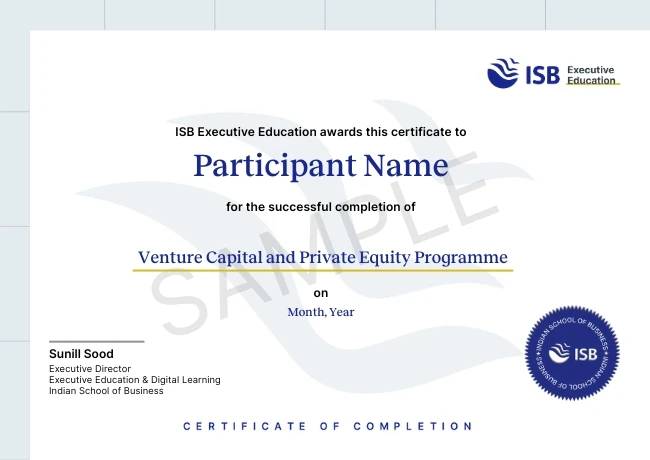
Upon successfully completing the programme with a minimum 70% score, you will be awarded a certificate in Venture Capital and Private Equity Programme from ISB Executive Education.
Note: All certificate images are for illustrative purposes only and may be subject to change at the discretion of ISB Executive Education.
Programme FAQs
The Venture Capital and Private Equity Programme at ISB Executive Education provides a comprehensive understanding of the venture capital industry, focusing on key aspects such as investment strategies, portfolio management, and exit strategies along with private equity modules. Participants will gain insights from industry experts and learn how to assess, manage, and scale high-growth ventures.
The VC Programme by the ISB Executive Education is designed for professionals, with 5+ years experience, aspiring to break into the venture capital and private equity industry or those looking to deepen their understanding of the field. It is ideal for entrepreneurs, investment professionals, and business executives who want to develop a strategic approach to venture capital investments.
The ISB Executive Education Venture Capital and Private Equity programme stands out due to its curriculum, which is designed by industry veterans and leading academics. The programme emphasises practical learning through case studies and real-world applications, preparing participants to navigate the complexities of venture capital and private equity markets.
Completing the Venture Capital and Private Equity Certificate Programme by the ISB Executive Education equips participants with the knowledge and skills needed to excel in the private equity industry. The certification enhances your credentials and opens doors to career opportunities in investment firms, private equity funds, and financial institutions.
The Venture Capital Programme offered by ISB Executive Education is distinct due to its focus on the early-stage investment landscape. Unlike other investment courses that may cover a broader spectrum, this programme delves deep into venture capital and private equity, providing specialised knowledge and insights that are crucial for success in this niche field.
Candidates applying for the programme are expected to have 5+ years of professional experience. The programme is designed for senior professionals who are either currently in or aspiring to understand the venture capital and private equity domain, ensuring a cohort of high-calibre participants.
After completing the VC Programme, participants can explore various career paths such as venture capital analysts, investment managers, and entrepreneurs. The programme also serves as a stepping stone for those looking to establish their own venture capital or private equity firms or lead investment divisions within existing organisations.
Upon successfully completing the Venture Capital and Private Equity Programme, participants will receive a certificate from ISB Executive Education, recognising their expertise in venture capital. This certification serves as a testament to the advanced skills and knowledge gained through the programme.
The fee structure for the Venture Capital and Private Equity Certificate Programme is designed to be competitive while providing significant value through the depth of content and access to industry leaders. For detailed information on the fees, including any available financial aid or payment plans, prospective participants can fill in the inquiry form on this page or connect with our programme advisors for more information.
Programme Fees: INR 4,61,000 + GST Flexi payment options and student loans available
Upon successful completion of the programme, participants will receive a digital certificate from the ISB Executive Education, recognising their advanced skills and knowledge in venture capital and private equity.
Early registrations are encouraged. Join now.
Flexible payment options available.
Starts On